


Cool bulk solids with 90% greater efficiency
Our heat exchange technology is capable of cooling bulk solids from up to 1,500°C indirectly by conduction, consuming up to 90% less energy. It’s engineered to handle substantial thermal stresses without cracking or damage, while offering guaranteed thermal performance for a superior end product.
Waste heat can be recovered and used elsewhere in the facility. No air is ever in contact with the product, virtually eliminating emissions, fines, bacterial and odour contamination.
A vertically oriented modular design uses little floor space and is easily expandable should capacity requirements increase.
How it works:
Watch the Solex heat exchanger in action:
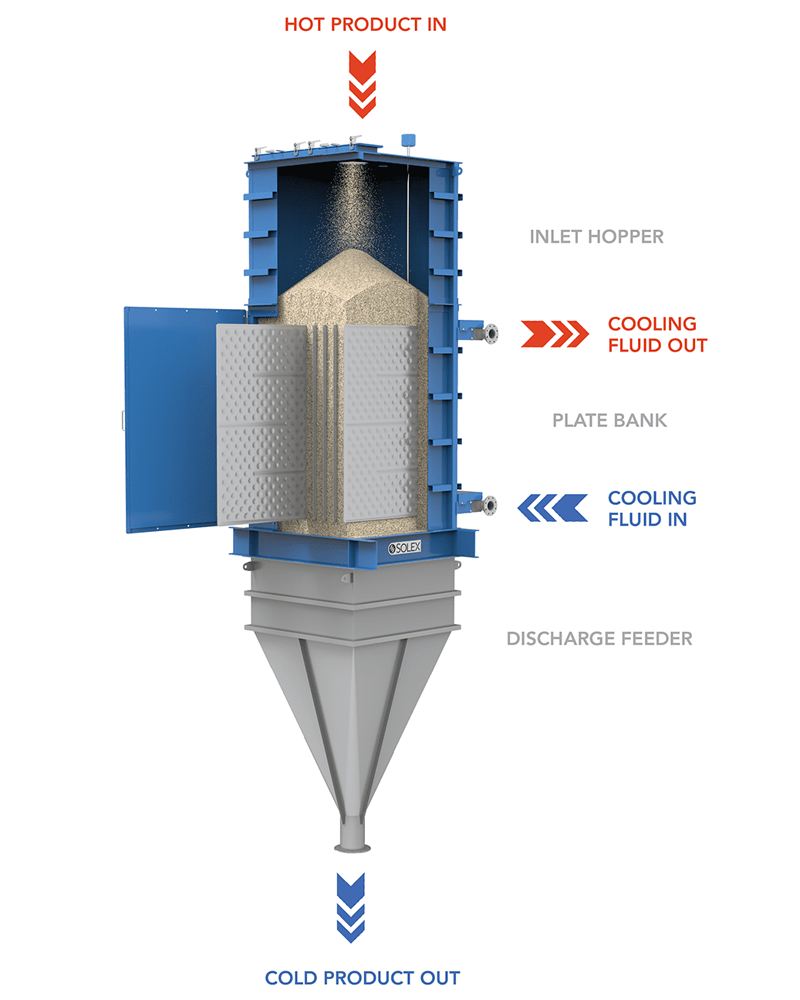
Controlled product flow : Free-flowing bulk solids pass slowly downward between a series of vertical hollow heat exchanger plates
Indirect plate cooling : Water or gas pass through the plates to cool bulk solids indirectly by conduction.
Mass flow : The mass flow discharge feeder creates uniform product velocity and regulates product flow rate.
Vertical model : Bulk solids pass through the vertical cooler by gravity, using no moving parts.
Benefits
Maximize energy efficiency
Save up to 90% more energy
Our heat exchange technology cools bulk solids using indirect heat transfer by conduction to substantially reduce energy requirements.
- The cooling technology uses indirect heat transfer, keeping air and fluid completely separate from the product being cooled. The exchanger’s design can use a variety of different heat transfer fluids including water, steam, thermal oil, air, nitrogen or other fluids.
- The bulk solid material moves slowly through the heat exchanger, avoiding the need to energetically mix the bed of material. This drastically mitigates the risk of attrition and dust while eliminating the need for large horsepower electric drives, big motors and other energy-consuming equipment.